

2. RIVALRY

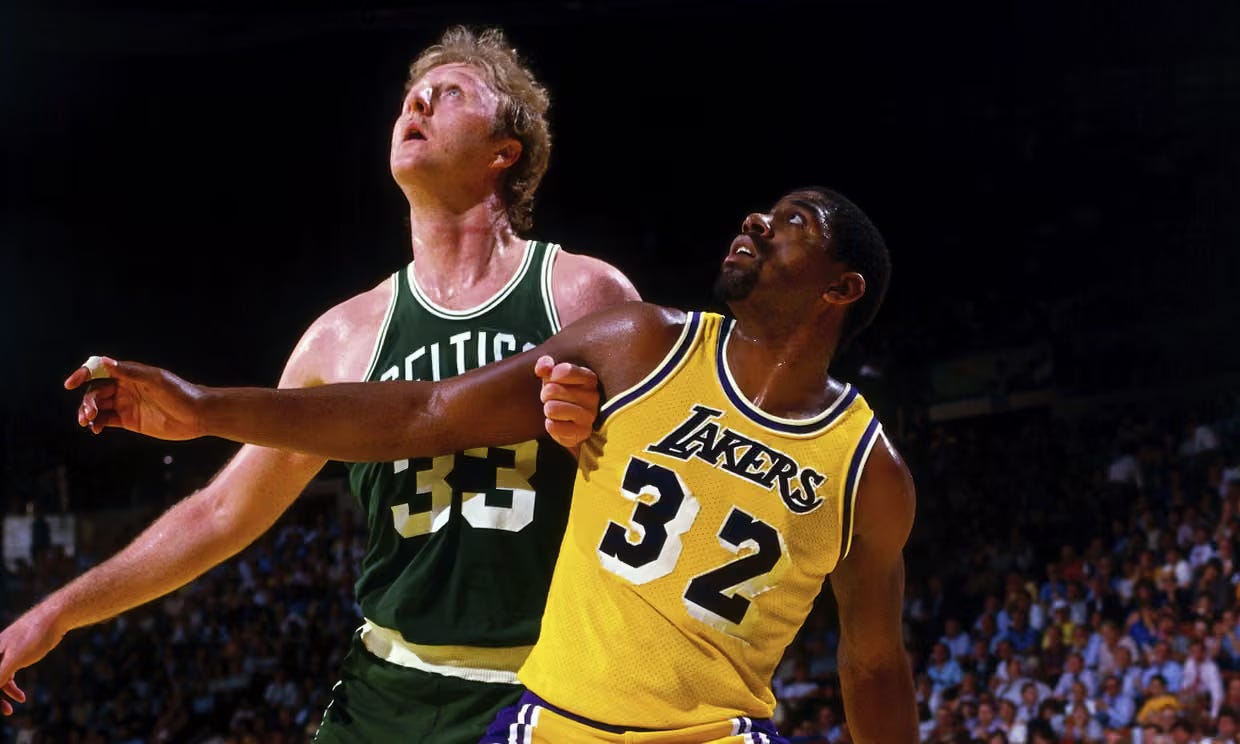
Bring back rivalry. I don’t mean between teams—that’s too abstract. Not to discount anyone’s tribal hatred of the Celtics, but true rivalry can’t exist except at the level of the individual; it’s too psychological. Even the greatest team rivalry in the history of the league—the 1980s Celtics and Lakers—had at its heart two men, Bird and Magic, whose rivalry stretched back to their battle in the 1979 NCAA Championship game.
What I want is the spectacle of irrational and long-standing hostility between two human beings as they strive for dominance and legacy. I want myth born from feeling and elevated by an audience of millions. I want a movie.
This dovetails with one of my larger issues about basketball that I’ll use to close my first year of fandom. The NBA has a narrative problem. I know who the best players are, but I don’t always know the protagonist. I can think of plenty of high-profile men whose names get thrown together on the basis of generation and competence—Jokic and SGA, Ant and Luka, Steph and LeBron—but none of these so-called rivalries are convincingly personal.
It’s embarrassing to admit how much this matters to me in the sense that it’s not really “about the basketball.” I think there’s an idea in sports that fandom can ascend to something that exists outside context, above narrative. That if you love the thing enough, you love it at the level of form. That aesthetic purity is also an escape from the limits of subjectivity.
I don’t actually know anyone like this, but I suspect a group of mouth-breathing analytics bros somewhere fit the bill. I know those boys would happily bitch me out for caring about something as “unserious” as emotional character. But you can hide behind your numbers all you want: basketball is nothing if not an emotion delivery system. And if it’s not, then what are we actually doing here?
Part of the problem these days might just be baked into the stars themselves. SGA is maddening to me on a number of levels. Stylistically, his nonchalance makes for basketball that I don’t always love watching, but it also translates to an existential disconnect off the court. He’s the poster child of cool-headed sportsmanship (derogatory). His ambition feels ethical, or at least it performs that way: you get the sense he wants to win so that he can grow, not because he wants to beat anyone else. At a loss, he radiates disappointment, never anger; emotion, when felt, seems like it’s always directed inward. I’m not saying this level of virtue is morally wrong. It’s just boring as fuck.
I’m picking on Shai because he’s the star player of the ruling championship team, but most of the top dogs are like this. Luka, for all his heated bitching on the court, seems capable only of rising to the emotional occasion when it comes to the refs. The love of my basketball life, Nikola Jokic, is no exception, though I give him a break on the basis of genius. Would it be nice if the best player in the world set the tone with some actual affect? Sure, but I’d like to think that when you’re that good, you get a pass. The man really does just float above the rest of us. That said, it’s not like genius makes everyone into a stoic. The ghost of MJ hovers eternally to remind us of that.
Anthony Edwards, the only truly cool NBA player, offers some hope. He’s not volatile or unpredictable so much as an old school, Hollywood beacon of charisma. It’s easy for me to picture Ant at a party, Ant spilling coffee, Ant taking a bite of cheesecake and moaning with pleasure—Ant as a person and not just Ant as a god. In the identification game “robot, human, alien,” you have to decide which of the two categories (max) you are. In a league of supercomputer superstars, Ant is human all the way down.
Edwards has had a series of memorable heated moments on the court — his swaggering trash talk against KD, his favorite player, in the 2024 playoffs against the Suns, comes to mind — but none that have carried into anything beyond outburst. Part of the problem could be that he’s on a team that no one really knows what to do with. Actual blockbuster rivalry is a convergence of player and team. The Celtics and the Lakers met on the Finals stage three times in the span of four years in the 80s, a heyday of rivalry. The Wolves are on murkier ground, stuck in a liminal hell of silver medal-hood, no longer eligible for the underdog arc, but not yet a champion.
Maybe it’s unrealistic for me to think that anyone with that level of responsibility and platform would ever visibly come undone in our internet age — how could Dennis Rodman exist in 2026? But even the most recent dynasty of Golden State had a legible and deeply compelling emotional center that Oklahoma City lacks.
Steph Curry and Draymond Green are a duo of epic sweep. Their connection has the splash of rivalry but with more novelistic complexity. The GOAT of my NBA twitter timeline, Jay Kang, recently compared them to Lila and Lenu, the Ferrante characters whose complicated female friendship took four books to capture. Here, style and character are inextricable: each offers an element of genius that can’t be fully realized without the other. “But who is really Lenu and who is Lila?” Not to mention a supporting cast with just as much intrigue—KD’s unceasing pursuit of acceptance, the tragedy and toll of Klay’s injuries, etc.
It’s not like the media isn’t trying with Oklahoma. Much has been made lately of the two ascendant giants of the West, the Spurs’ Victor Wembanyama and OKC’s Chet Holmgren, and their supposed beef. I say “supposed” because I don’t think anyone actually believes in it. If only it had the legs of either of its players.
I think that’s part of why rivalry is so valuable. It’s one of the only things left that’s hard to fake. When it’s real, it’s undeniable—an easy enough sniff test. Conflict can be shaped and sometimes created by media but not on so grand a scale. You just can’t top-down hostility. Cut all you want to Chet after every Wemby dunk: his blank, bovine stare tells us everything we need to know. For his part, Wemby is committed to fury, but until it’s reciprocal, it doesn’t count.
I’m not saying every player needs to be Ja Morant and thank god they’re not. This whole argument goes south if it’s reduced to a desire to see players lose their game in the name of interpersonal drama. You don’t actually want rivalry to come at the cost of talent. Part of the genius at play with someone like MJ was the way his passion was always in service of skill and not in spite of it.
But I do want my players — or at least, my stars — to be a little evil. As Leonard Koppett writes in The Essence of the Game is Deception:
To be a basketball coach, or player, or a deep-dyed fan, you don’t have to be crazy, but you do have to have a streak of deviousness somewhere within you. And deviousness is a quality that can work itself in a sort of inward spiral… It was once said about a particular wild-eyed athlete whose psychiatric history was a matter of public record (and his profit): ‘He isn’t really crazy, he just acts crazy because he wants you to believe he’s crazy.’ ‘That’s true,’ agreed another analyst …’But maybe to act that crazy on purpose you have to be a little crazy.’ That sums up basketball to perfection.
Anyone who performs at the level of a professional athlete is familiar with the dark side of competition and ego. I’d rather see that shadow self on display than have to deal with the performance of some hollow virtue. Let’s stop pretending like ambition rewards restraint. It’s okay to go a little crazy. Sometimes it gets you where you need to go.
Here for the Shai slander. The other side of this is maybe the allure of friendship, seeing a team cohere as a unit. Why the Pacers last season were kind of lovable, and why it was so tragic seeing Tyrese go down in game 7. Pathos! Theater! great post